I Got These Guns from My Dad: A Designer's Review
As someone who has spent years evaluating digital assets for real-world embroidery, I have learned that the most charming designs are often the ones that balance humor with technical feasibility. Recently, I came across a file titled I Got These Guns from My Dad. At first glance, it looks like a standard funny kids quote, but before you download it for your next Etsy listing or family gift, you need to understand how this design translates from a screen to a stitched reality. This review breaks down the practical application of this graphic for designers, small business owners, and crafters.
The First Impression: Mood and Visual Personality
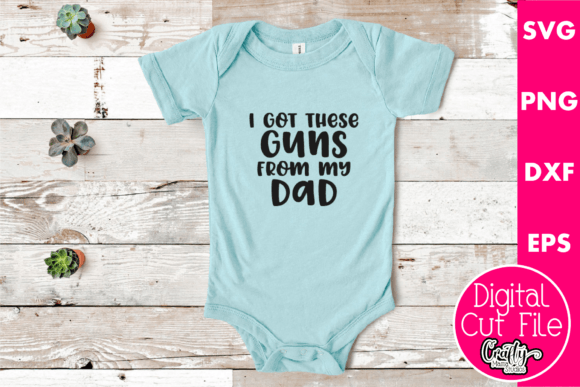
The phrase "I Got These Guns from My Dad" immediately sets a playful, slightly mischievous tone. It is perfect for a child's wardrobe or a humorous holiday gift. However, as an experienced designer, my initial reaction isn't just about the text; it is about the layout. Does the spacing allow for proper stitching? Is the font style sturdy enough to hold up under the tension of machine embroidery? The design creates a mood of familial bonding mixed with childhood bravado. It feels natural on a baby onesie or a toddler's t-shirt, where the contrast between the innocent wearer and the bold statement creates an instant emotional connection with parents and grandparents.
The visual personality here is casual and approachable. It does not scream "high fashion," but rather whispers "fun handmade gift." For a boutique product or a small shop merchandise line, this kind of relatable content drives engagement. Customers buying these items are often looking for something personal and unique, not mass-produced perfection. The design promises exactly that: a custom feel that acknowledges the bond between parent and child.
Real-World Application: From Screen to Stitch
Let's imagine a specific scenario. You are preparing for a local craft fair or finalizing a batch of custom orders for a client. You decide to use I Got These Guns from My Dad on a custom embroidered tote bag made of heavy canvas. This is a classic choice for a craft business because the fabric provides a stable base for the design. However, if you were to move this same design to a stretchy sweatshirt or a thin cotton tee, the outcome might differ significantly.
In a commercial embroidery setting, the versatility of this design is key. It works well as a standalone graphic on a chest pocket area of a hoodie, serving as a subtle nod to fatherhood. Alternatively, it could be the centerpiece of a nursery decor item, such as a pillow cover or a blanket. The text-heavy nature of the file means it requires careful attention to thread color contrast. If you are using white thread on a dark fabric, you must ensure the stitch density is high enough to prevent the background from showing through. Conversely, on light fabrics, a darker thread will make the message pop without requiring excessive backings.
For those selling digital products, this design offers great potential for printable mockups. You can visualize how it looks on various apparel types before committing to production. When used in a finished product, the clarity of the lettering directly impacts customer trust. If the stitches look messy or the letters are too close together, the perceived value of the handmade item drops. But when executed correctly, I Got These Guns from My Dad elevates a simple garment into a memorable keepsake.
Where Caution is Required
While this design is versatile, there are specific scenarios where you should proceed with caution. Small hoop sizes are a major constraint. If the design includes intricate details or dense fill stitches, attempting to fit it into a 4x4 hoop might result in distorted lettering or skipped stitches. Similarly, textured fabrics like waffle-knit hoodies or fuzzy fleece can hide the definition of the design, making the text harder to read.
Stretchy fabrics present another challenge. Without the correct stabilizer, the tension of the embroidery machine can cause the fabric to pucker around the letters. Dark fabrics require a top backing to prevent the design from sinking into the material, while thin fabrics may tear if the stitch density is too aggressive. Curved surfaces, such as caps or hats, demand precise digitizing adjustments to ensure the text follows the curve naturally rather than looking warped.
Impact on Product Value and Brand Consistency
When you integrate a design like this into your craft business, you are building a brand identity. I Got These Guns from My Dad fits well within a niche focused on family-oriented gifts, personalized apparel, or humorous children's wear. The consistency of the design quality across your product line tells customers that you care about the details. A clean, professional finish on a tote bag or a baby item reinforces the idea that your handmade products are worth the price.
Furthermore, the design's humor makes it highly giftable. Whether it is for Father's Day, Christmas, or a birthday, the item becomes a conversation starter. This increases the likelihood of repeat purchases and referrals. However, if the stitching is poor, the humor falls flat, and the item ends up in the trash rather than on display. Ensuring that your embroidery project results in a crisp, clear image is essential for maintaining buyer engagement and professional reputation.
Practical Notes for the Embroidery Designer
Before you hit the start button on your machine, there are several critical steps to take. First, always test the design on scrap fabric. This allows you to check the thread color contrast and inspect the stitch density without risking your actual product. If the design includes tiny lettering, zoom in on your computer screen and verify that the individual characters are distinct enough to be rendered by your machine.
Review the file formats provided. The description mentions SVG, EPS, DXF, and PNG files. While these are standard for cutting machines like Cricut, ensure they are also compatible with your embroidery software. If the file is primarily a cut file, you may need to convert it or trace it carefully to create a viable machine embroidery design. Check the licensing terms explicitly. Some files are for personal use only, while others allow for commercial sales of finished items. Confirming this before you start production protects your small business from legal issues.
Don't forget to select the proper stabilizer. For a design with significant text, a cut-away stabilizer is often best for durability, especially on garments that will be washed frequently. Test the design in black and white mockups to see if the contrast holds up visually. Finally, compare the design on both light and dark backgrounds to ensure the thread colors chosen provide maximum visibility.
Final Thoughts on Design Assets
I Got These Guns from My Dad is more than just a funny quote; it is a strategic asset for anyone in the handmade market. It captures a universal sentiment that resonates with buyers, provided the execution is flawless. By understanding the nuances of fabric texture, hoop size, and stitch density, you can transform this digital file into a tangible, high-value product. Whether you are creating a single personalized gift or scaling up for an Etsy shop, taking the time to evaluate the design's performance ensures that your final product stands out.
Remember, the success of any embroidery project lies in the preparation. Take the extra step to test, adjust, and refine. When done right, a design like this doesn't just decorate a shirt; it tells a story, strengthens a brand, and brings a smile to the recipient's face. That is the true value of a well-executed graphics asset in the world of handmade crafts.